Addressing bylaw enforcement in Surrey
We aim to foster a fair and equitable community for all Surrey residents. Discover the critical issues we're tackling to improve bylaw enforcement protocols and how your involvement can make a difference. Join us in advocating for positive change.

Subjectivity versus Objectivity
in bylaw infractions
Not all bylaw infractions are equal in their objectivity. Some violations are clear, measurable, and binary; for example, a structure exceeding stated allowances either has a permit or it does not. Other infractions involve substantial subjectivity, such as the height of a hedge, the accumulation of items in a yard, the appearance of a property, or noise thresholds. For these complaints, a single complainant’s perception may not accurately reflect the situation or community standards. The line between a legitimate concern and a personal dispute can be difficult for an officer to assess during a brief inspection visit. The current protocol applies the same enforcement trigger—a single complaint—to both objective and subjective categories. This creates a disproportionate enforcement risk in the subjective category, where the threshold for triggering officer time, property inspection, potential fines, and reputational harm to a neighbour is too low.

How bylaw issues affect Surrey homeowners and residents
Surrey’s own bylaw enforcement already applies a corroboration requirement to barking dog complaints, providing an existing precedent. In this model, a complaint from a single resident is not sufficient to trigger formal enforcement; a minimum of two independent neighbour reports is required.
This standard exists precisely because noise perception is subjective and varies by individual sensitivity, and dog ownership disputes can often be a vehicle for neighbourly targeting.

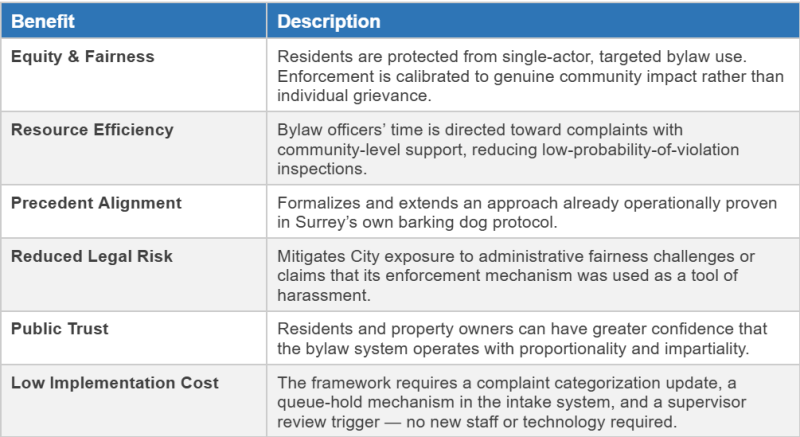
A two-complainant threshold provides a low-burden but meaningful signal that the issue is community-level rather than personal. This model is administratively simple, operationally established, and legally defensible. It does not prevent legitimate enforcement, as genuine community nuisances will readily attract multiple complainants. What it does prevent is the single-actor bad-faith complaint that burdens both the target and the City.
Proposed changes for Improved Bylaw Enforcement Protocols
We propose a Tiered system for complaint categories to ensure fairness and efficiency:
The proposed framework includes the following operational safeguards to prevent gaps or abuse in the opposite direction:
Tier 2 complaints would be logged and held in a queue upon initial receipt. The complainant is notified their report is recorded and awaiting additional corroboration. This ensures transparency and prevents the misuse of the system.
Create Your Own Website With Webador